This page describes the terminology and naming conventions used throughout stairtools to represent stair geometry.
Details
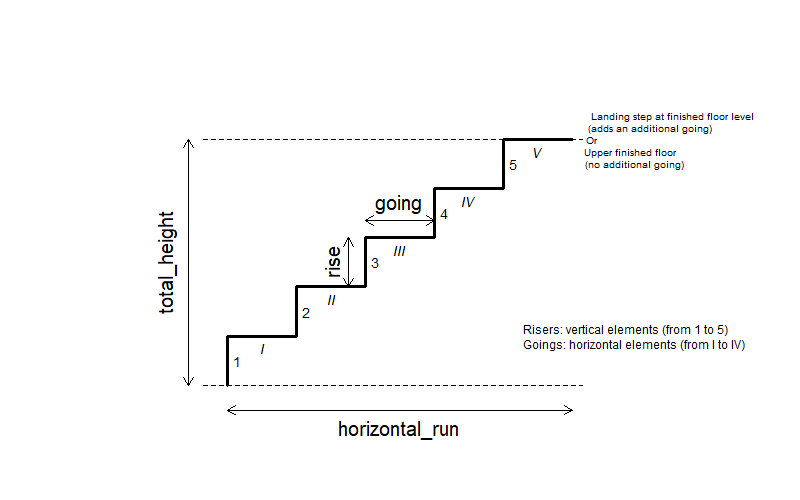
The package uses the following conventions:
total_height: total vertical distance between the lower and upper finished floors;rise: vertical height of one riser;n_risers: number of risers required to reach the upper floor;going: horizontal depth of one tread;horizontal_run: total horizontal footprint of the staircase.landing: Horizontal platform reached at the end of a staircase. The last going may lead either to a landing or directly to the upper finished floor.
A riser is the vertical element between two consecutive treads. A going refers to the horizontal depth of a tread (horizontal surface of a step).
A complete step is composed of one riser and one tread. The package
uses n_risers rather than "number of steps" because the number
of vertical increments is the quantity required to compute the total
height of a staircase.
Stair comfort is commonly evaluated using Blondel's formula:
$$2 \times rise + going$$
where rise and going are expressed in centimetres.